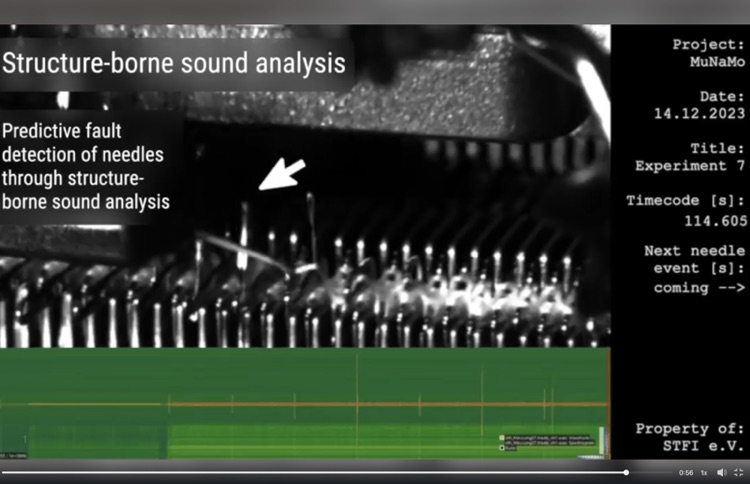
Chemnitz – Terrot will present new work on AI-assisted predictive maintenance for circular knitting machines at the Techtextil Forum during next week’s Techtextil 2026 in Frankfurt.
The company’s R&D team will outline how acoustic and vibration data can be used to detect critical machine conditions before fabric defects become visible in production.
Michael Lau, head of R&D at Terrot, is scheduled to explain how AI-driven analysis of machine sound and vibration enables earlier identification of emerging faults. His presentation will focus on conditions such as needle breakage, misalignment and insufficient lubrication, which can lead to costly stoppages and quality issues if they are not recognised at an early stage.
The work is based on the MuNaMo project, developed in collaboration with the Sächsisches Textilforschungsinstitut e.V. (STFI – Saxon Textile Research Institute). According to the partners, MuNaMo combines internal machine signals with external sensor data to create a multidimensional view of the knitting process, improving the reliability of fault detection.
“MuNaMo” is derived from the German “Multidimensionale Nadelfehlererkennung und Modellierung”, underlining the project’s focus on needle fault detection and modelling.
In practical terms, the system is designed to identify critical events such as needle damage or misalignment at an early stage, reducing unplanned downtime and minimising yarn and fabric waste. By stabilising the knitting process, the partners aim to support mills running high-demand production, where unscheduled stoppages and off-quality fabric can quickly erode margins.
The MuNaMo approach has been validated under real production conditions on Terrot’s RH 216-I circular knitting machine, indicating its potential for application in industrial environments. The partners see this as a step towards scalable, retrofit-ready AI assistance systems that can be integrated into existing knitting equipment as well as new installations.
For knitwear and hosiery manufacturers, such monitoring concepts are closely linked to broader objectives around efficiency, digitalisation and quality assurance. As mills come under pressure to improve overall equipment effectiveness, reduce waste and document process stability, data-driven condition monitoring is expected to become increasingly relevant.Â