Albstadt - Circular knitting machine builder Mayer & Cie will mark several 'firsts' when it unveils its booth at the upcoming ITMA Asia + CITME exhibition.
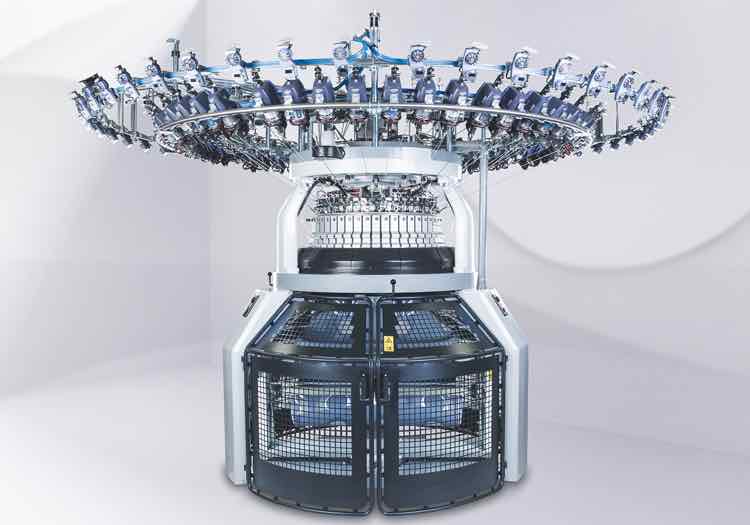
At this year's show, to be held from 15 to 19 October in Shanghai, the Albstadt-based firm will be focusing entirely on electronic machines with a line up that includes the Spinit 3.0 E, the OVJA1.6 EE 3/2 WT and the OVJA 2.4 EC.
It will be the first time the Spinit spinning and knitting machine and the OVJA1.6 EE 3/2 WT, designed specially for knitting shoe uppers, have been exhibited in China. It will also be the first time ever that the OVJA 2.4 EC, a new electronic jacquard machine that Mayer & Cie China (MCN) has added to its product line, and MCN's first electronic machine.
Explaining the thinking behind the machine selection, Rudolf Crass, Mayer & Cie’s regional sales manager with responsibility for China, said the company had, for some time, noticed an increase in demand in the high-end machine segment in China. "High-output circular knitting machines are trending too,” he said.
Falling into this category is the new OVJA 2.4 EC which, with 2.4 systems per inch, is a full jacquard machine that outperforms Chinese manufacturers’ conventional models in productivity. Thanks to its three-way-technology, the OVJA 2.4 EC is said to offer great variety in design patterns. It is aimed at discerning Chinese customers who produce fabrics for outer garments, sports and leisurewear.
Its design is borrowed from that of the successful OVJA 2.4 SE mini-jacquard machine and its functionality is based on that of the OVJA 2.4 E full jacquard machine. The most important difference between it and the two machines on which it is modeled is the implementation of the needle selection. The OVJA 2.4 E relies on electronic individual needle selection on one track via the control board and the Chinese model uses 16 athermal electromagnetic actuators on eight tracks. “That has advantages in terms of user friendliness because gauge changes are faster and easier,” Crass explains. “It is also more attractive in terms of pricing combined with high productivity. Not to mention easy spare parts availability for it being domestic system.”
The OVJA 2.4 EC is the first electronic machine to be finally assembled at Mayer & Cie China. During the past few years, the Chinese works have continually expanded their portfolio. The most successful – and first – Chinese model is the MSC 3.2 II single jersey machine and its double jersey counterpart, the MDC 2.2. Since the end of 2017, a Relanit 3.2 SC with Mayer & Cie’s tried and trusted relative technology has completed the portfolio for the domestic market. All four machines come with a knitting head made in Germany while different frame and control panel components are manufactured in Shanghai for final assembly.
Anticipating significant interest in the Spinit 3.0 E, Michael A. Tuschak, Mayer & Cie.’s spinitsystems marketing and sales manager said that the the technology was mainly of relevance in established textile markets with larger companies, such as full-service enterprises or spinning mills with forward integration, constantly looking for ways in which to set themselves apart from the competition.
“We are delighted to be able to present our Spinit 3.0 E spinning and knitting machine ‘in the flesh’ at this year’s ITMA Asia," he said. "The technology, how it works and above all the result are always demonstrated the most impressively on the machine itself.
According to Tuschak, with spinitsystems, Mayer & Cie can its customers something new. For example, the product the machine makes such as the Spinit Fancy Jersey which with its characteristic pattern variations can only be made on the Mayer & Cie. machine.
The Spinit 3.0 E also offers benefits in the manufacturing process. To produce single jersey it requires much less energy, time and space than the conventional process, a point illustrated by its recent receipt of the German Environment Ministry’s Innovation Prize for the Climate and the Environment (IKU).
The third machine on offer is the OVJA 1.6 EE 3/2 WT, described by Hardy Bühler, Mayer & Cie.’s Key Account Manager Brands as the company's "first ‘real’ shoe machine.
Noting the specific requirements of the shoe upper fabric growth market this new model uses three-way technology in the cylinder and two-way technology
in the rib dial. This ensures a very wide range of patterns for the multi-colour jacquard machine, which can at the same time produce a hole structure look by means of multiple tuck loops. It also produces plain and multi-coloured spacer fabrics up to 5 mm thick, which Bühler says is very much in demand for shoe uppers.
Mayer & Cie points out that producing spacer fabrics on a circular knitting machine makes sense for several reasons. For one, set-up times are much shorter than when using other means of production.
A circular knitter also uses much less yarn to make multi-coloured spacer fabrics. That above all, Bühler says, makes manufacturing small batches of spacer on a circular knitting machine a success.
In addition to the OVJA 1.6 EE 3/2 WT, the Mayer & Cie portfolio includes several machines that are suitable for making shoe upper fabric, particularly the OVJA machines although also worthy of note is the Technit D3, a spacer specialist that knits with three threads on the cylinder side and produces spacer structures with four needle tracks.