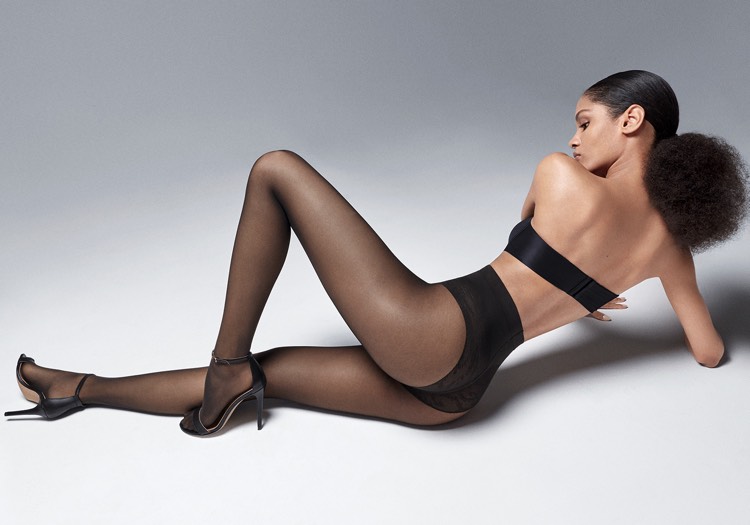
Bregenz – Wolford is reinforcing its position in high‑quality circular knit legwear and bodywear with a 2025 R&D programme centred on finer‑gauge engineering, new yarn technologies and digital product development.
The group, which manufactures exclusively in Europe at its Bregenz (Austria) and Murska Sobota (Slovenia) sites, continues to target premium “skinwear” applications ranging from tights and shapewear to seamless bodysuits and close‑fitting ready‑to‑wear.
A key technical focus in 2025 was the refinement of Wolford’s proprietary circular knitting platforms used for legwear and bodywear, including the integration of ultra‑fine yarns on machines configured with a 32G bank of machines.
This configuration underpins the company’s “second‑skin” fit, enabling high levels of stretch and recovery while maintaining stitch stability in very fine deniers. The same technology supports engineered patterning such as knitted‑in drape, shaping zones and seamless transitions between different fabric structures within a single tube.
The Sheer Drape capsule illustrates this approach, using yarns normally reserved for tights machines to create ready‑to‑wear pieces with draping effects knitted directly into the fabric. According to the company, the key innovation lies in the interplay between yarn selection and circular‑knit programming to achieve fluid drape without sacrificing fit or ladder resistance. For mills supplying brands in dresses, skirts or tops, this type of knitted‑in shaping may open up alternatives to cut‑and‑sew constructions based on wovens or heavier jerseys.
Alongside this, Wolford expanded its work with Merino wool in circular knit structures, in partnership with The Woolmark Company. Ultra‑fine Merino yarns are processed on proprietary machines to produce smooth, elastic and largely seamless fabrics, combining warmth with a close, body‑hugging fit. All styles in this capsule carry Woolmark certification, giving brand customers an externally verified handle on fibre quality and performance.
On the yarn side, the company reports further development of smart and sustainable fibres including EMANA smart polyamide and BLUFIBRE derived from up‑cycled tyre waste. EMANA is used to enhance Wolford’s long‑standing “Black & White Technique”, combining higher comfort and softness with far‑infrared functionality aimed at thermoregulation and skin well‑being in hosiery and bodywear lines. BLUFIBRE is being integrated into selected lines to increase the share of circular raw materials without compromising the fine gauges required for premium legwear.
Digitalisation of sampling and pattern development advanced significantly, with “full 3D integration” now used to reduce physical prototypes, accelerate internal validation and support photorealistic visualisation for wholesale presentations. The company reports that 3D tools allow rapid colour and pattern iterations across legwear and bodywear collections, with digital showrooms increasingly complementing traditional collection showings.
For knitting mills and brands, this shift is intended to shorten development cycles, reduce yarn and sample wastage, and improve cost forecasting.
From a production standpoint, Wolford says it continued a multi‑year programme of consolidating and modernising its knitting and finishing base in Bregenz and Murska Sobota.
Process steam for dyeing, moulding and heating is supplied by boilers with installed capacities of 7.9 MW and 4.5 MW at Bregenz, with efficiency improvements guided by Austria’s Federal Energy Efficiency Act (EEffG).
In sustainability, both production facilities obtained Hohenstein SteP certification in 2025, while the vertically integrated legwear and bodywear ranges remain backed by long‑standing bluesign approval and OEKO‑TEX Standard 100 compliance at supplier level. Wolford reports that around 90 per cent of its material suppliers are based in Europe and that about 90% of its products now qualify for the Hohenstein “Made in Green” label.
Current R&D priorities include recyclable elastane alternatives, more energy‑efficient knitting processes and improved material traceability, often in collaboration with the University of Innsbruck and specialist yarn partners.
At the product‑portfolio level, legwear remains Wolford’s largest category, accounting for 44% of 2025 revenues, followed by ready‑to‑wear at 43% and lingerie at 12%.
Essentials, which covers core tights, bodysuits and key silhouettes, contributes about 73 per cent of sales and is used by management to anchor working‑capital efficiency and NOOS (Never‑Out‑Of‑Stock) service levels to key customers.
Trend collections and a small “Fashion Lab” capsule, often developed with external designers, provide seasonal updates and collaboration opportunities while representing a minority of volume.
To support these product strategies, Wolford says it continued to streamline its retail and logistics footprint, including the relocation of its central warehouse to Munich in 2024 and further optimisation measures in 2025.
The group now serves 41 markets with 132 monobrand points of sale – of which 43 are partner‑operated – and an online business that accounted for 22% of sales last year.
Management says the focus is on improved delivery reliability, shorter replenishment lead times and more disciplined inventory control, particularly for NOOS lines.
“Following the yyear 2024 – marked with significant disruption – 2025 began under significant pressure, as the company continued to work through the operational, liquidity and organisational challenges that had emerged,” the management board said in the report.
“The turning point of this journey was achieved in the first half of 2025. The management team acted with discipline and urgency, tightening cash governance, re-engaging suppliers, prioritizing operations and production, and sharpening decision rights – so that tight financial control could be achieved.
“Clearing out of obsolete stock simplified assortments and supported cash generation; and our retail perimeter was streamlined with the closure of non-profitable stores, improving structural efficiency.
“In the second half of 2025 operations stabilized gradually. Supply and delivery reliability increased; and momentum returned with wholesale partners and direct to consumer customers. Consistent with our plan, we expect to fully recover the NeverOutOfStock (NOOS) backlog in the first quarter of 2026, further strengthening product availability and commercial execution.”
Looking ahead, Wolford plans to relocate its Austrian production operations within the Vorarlberg region in 2027 as its existing Bregenz production lease approaches expiry, and says it does not expect knitting capacity constraints during the transition.
The company also expects gradual market improvement in 2026, with low single‑digit growth in personal luxury goods and a continued premium on operational discipline, service levels and credible sustainability performance across the hosiery and bodywear supply chain.
“Our product path remains grounded in what Wolford does best,” the statement added.
“Essentials continue to anchor our offer proposition, supporting agility, delivery speed and disciplined use of working capital. Alongside this, we are keeping newness sharply curated with faster reads and tighter edits.
“Importantly, the AW26 product development pathway was initiated ahead of the second half of 2025, as part of the transition from stabilisation to development, ensuring continuity between design and operations.”